
TL;DR
- F1 points are straightforward only after you account for sprint points, DNFs that are still “classified”, disqualifications, and shortened-race scaling.
- From 2025 onwards there’s no fastest lap bonus, so the maximum a driver can score on a normal weekend is defined by finishing position (plus Sprint points if applicable).
- The important skill isn’t memorising the table — it’s understanding what actually changes the classified order (penalties, DSQs, classification rules) and how that flows into points.
- Use RaceMate’s F1 Championship Calculator to run scenarios properly: change one finish, add a DNF, flip a sprint result, and watch how the title math moves.
- Don’t chase “predictions”: treat the calculator as a controlled environment for assumptions, tradeoffs, and uncertainty.
Formula 1 points look like a simple lookup table until you try to answer a real question: “What does my driver actually need over the next three rounds if there’s a Sprint weekend, a likely DNF risk, and one penalty swing?” That’s when you discover the championship isn’t a narrative — it’s a constrained system. Points don’t just reward “pace”; they reward classified finishing position, which is shaped by rules, incidents, and edge cases. This guide breaks down how F1 points are really calculated, then turns those rules into live, runnable examples inside RaceMate’s championship tool so you can model outcomes instead of arguing about them.
The points tables (Grand Prix vs Sprint) — and what “no fastest lap” changes
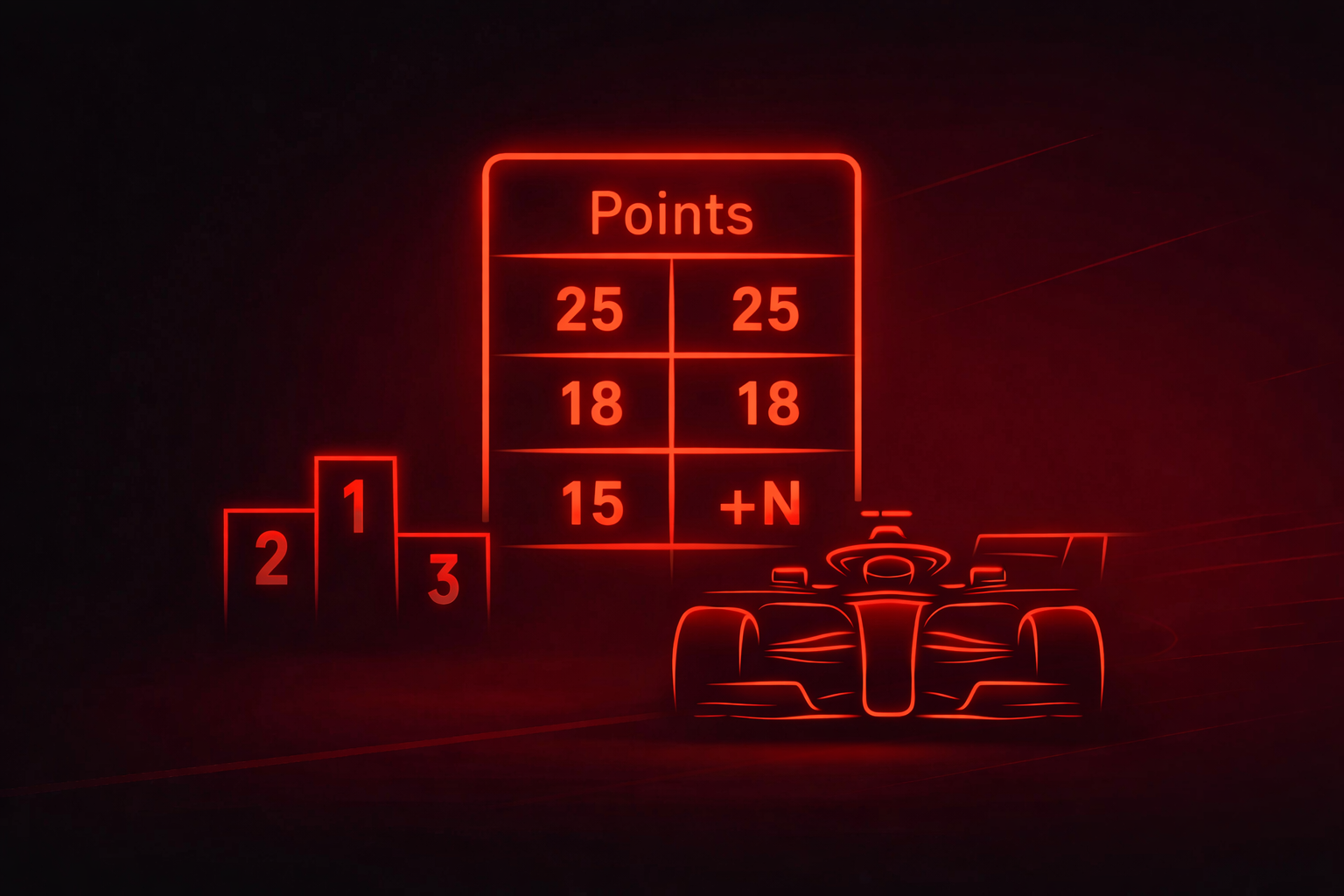
For a standard Grand Prix, Formula 1 awards points to the top 10 classified finishers. The scale is intentionally steep at the front because the sport wants wins and podiums to matter more than incremental midfield gains. The current Grand Prix points are:
| Finish | Points |
|---|---|
| 1st | 25 |
| 2nd | 18 |
| 3rd | 15 |
| 4th | 12 |
| 5th | 10 |
| 6th | 8 |
| 7th | 6 |
| 8th | 4 |
| 9th | 2 |
| 10th | 1 |
Sprint weekends add a second, smaller points layer. In a Sprint race, points go to the top 8:
| Sprint finish | Points |
|---|---|
| 1st | 8 |
| 2nd | 7 |
| 3rd | 6 |
| 4th | 5 |
| 5th | 4 |
| 6th | 3 |
| 7th | 2 |
| 8th | 1 |
From 2025 onwards, there is no fastest lap bonus point. That matters for modelling because it removes a small but strategically “gameable” swing. If you’re using a calculator as a decision tool, eliminating that extra point reduces a common source of confusion: you no longer need to ask whether a fastest lap was set by someone in the top 10, whether a late pit stop was “worth it”, or whether a backmarker could steal the point. In RaceMate, that means your scenario outcomes are driven by finishing position (and Sprint finishing position where applicable), which keeps the simulation cleaner and easier to interpret.
Why points aren’t just a table: classification, DNFs, penalties, DSQs
The hidden complexity in F1 points is that points are awarded based on the official classified result, not “who looked fast” or “who crossed the line before the stewards’ document dropped.” That classified order can change after the chequered flag due to time penalties, grid penalties that were applied before the start (which reshuffle the grid but not the finish), or post-race decisions.
Two edge cases matter most when you’re using an F1 points calculator to model a championship.
First: DNF doesn’t automatically mean zero points. A driver can retire late and still be classified if they have completed enough race distance relative to the winner (this is why you’ll sometimes see a car “retired” but still listed 9th or 10th). In practical terms, if a late retirement happens after the field is sufficiently spread and the driver has completed enough distance, the driver can still take points — and that can completely change a title swing scenario you thought was “safe.”
Second: DSQ overrides everything. A disqualification means the driver is removed from the classification for the purposes of results and points. Everyone behind is promoted, and the points shift upward accordingly. For championship modelling, DSQs and penalties are why you should treat points as an output of a rules system, not as a direct proxy for on-track pace.
RaceMate’s approach in the F1 Championship Simulator is to make you model what the championship actually counts: the classified finishing positions (and Sprint positions). If your scenario includes a penalty swing, you don’t need to invent a new points rule — you just change the finishing order and let the calculator do the math.
How to use RaceMate as an F1 points calculator (the workflow that avoids mistakes)
If you want a calculator to be useful beyond trivia, it needs to support the way fans and analysts actually think: “What if this driver finishes P2 instead of P5?” “What if there’s a Sprint and they only manage P7?” “What if a DNF becomes a classified P10?” The point of RaceMate’s F1 Championship Calculator is that you can turn those questions into controlled inputs.
Start by opening F1 Championship Simulator and setting the season context you care about. The calculator works best when you treat it like a scenario engine: lock in the current points baseline, then modify only the variables you’re testing (one driver’s finish, one team’s double-score, one Sprint result). The output is only as honest as the assumptions you feed it — but that’s a feature, not a bug, because it makes uncertainty explicit.
Most importantly, interpret the results as conditional: “If these finishing positions happen, the points become X.” That framing prevents the most common misuse of simulators: mistaking a scenario for a forecast.
Live examples you can run right now in the Championship Calculator
Example 1: The “small” finishing-position change that isn’t small
Run this scenario in F1 Championship Simulator: pick any remaining Grand Prix in your season model and set Driver A to finish P2 and Driver B to finish P5. Now rerun the same weekend with just one change: swap Driver B from P5 to P3.
On paper, P5 to P3 feels like “two places.” In points, it’s a different story because the scale is non-linear: P3 pays 15, P5 pays 10, so that’s a 5-point swing from a single driver. If Driver A stays P2 (18 points) in both cases, the gap to Driver B changes materially without needing any dramatic “win vs DNF” storyline. This is exactly why championship modelling should start with finishing-position deltas rather than vague statements like “they were quicker this weekend.”
Use the calculator output to sanity-check your intuition: if your mental model says “that doesn’t matter much,” the points table will often disagree.
Example 2: Sprint weekends: one weekend, two points layers, different risk profiles
Now add a Sprint. In F1 Championship Simulator, set a Sprint result where Driver A finishes P6 in the Sprint and P4 in the Grand Prix, while Driver B finishes P2 in the Sprint and P6 in the Grand Prix.
This is where many “back-of-the-envelope” calculations go wrong: they accidentally mix Sprint pace narratives into Sunday points, or they forget that Sprint points are smaller but still meaningful. In this example, Driver A gets 3 points from the Sprint (P6) plus 12 from the race (P4) for 15 total. Driver B gets 7 from the Sprint (P2) plus 8 from the race (P6) for 15 total. Same weekend total, completely different shape.
The analytical takeaway isn’t that Sprint “doesn’t matter” — it’s that Sprint weekends create more ways to arrive at the same total, which increases uncertainty. In modelling terms, you should treat Sprint points like a second dice roll: lower magnitude than the Grand Prix, but capable of flipping momentum when the margins are tight.
Example 3: DNFs that still score: the classification trap
To model this properly, you need to separate three outcomes that fans often lump together:
A retirement can produce (1) a classified points finish, (2) a classified non-points finish, or (3) an unclassified result that scores nothing. The championship only cares about which bucket the final classification lands in.
In F1 Championship Simulator, run two versions of the same race:
In Scenario A, set Driver A as P10 and mark Driver B as P11. Scenario B: flip it — Driver B is P10 and Driver A is P11. The points swing is only one point, but in a tight title fight that can be the difference between “needs a win” and “needs P2 with fastest lap” (which is no longer a thing after 2025).
Now reinterpret that swap as a late-race retirement: if a driver retires late but is still classified P10, they can still bank that single point — which is why “DNF = zero” is a modelling mistake. The clean way to think is: what would the official classified position be? Then input that position and let RaceMate calculate the rest.
Example 4: Shortened races: scaled points, and why distance thresholds matter
A race that doesn’t reach full distance doesn’t automatically pay “half points” anymore. Points can be scaled based on how much of the scheduled distance the leader completes, and there is also a minimum-racing requirement for any points to be awarded.
In practical scenario terms, you should model shortened races as a different points table attached to the same finishing order. If the race ends early, the points available at each position can be lower — which means a “damage limitation P6” might be worth less than you expect, and a rival’s “lucky P2” might not hurt as much as it would in a full-distance Grand Prix.
In F1 Championship Simulator, the right way to use this is not to guess what the stewards will do. Instead, decide which distance band your scenario assumes (for example: a race that runs past the halfway mark but not to full distance), then run your finishing-order assumptions under that band. If you’re comparing strategies or risk profiles, test the same finishing order under both a full-distance and a shortened-distance assumption to understand how sensitive your championship outcome is to disruption.
Interpreting simulator outputs: what’s signal, what’s noise
An F1 championship calculator is most valuable when you treat it like an engineering model: outputs are only meaningful relative to inputs, and uncertainty isn’t an inconvenience — it’s the point. If your scenario assumes perfect reliability, perfect stewarding clarity, and zero variance in qualifying, the calculator will happily give you a crisp answer that the real world will rarely respect.
So when you use F1 Championship Simulator, build scenarios that reflect ranges, not single lines. Run the “clean weekend” version, then run the “messy weekend” version with a single DNF, a Sprint underperformance, or a small finishing-order shuffle. If the title outcome flips easily, that’s not a failure of the tool — it’s a diagnosis that the championship is currently high leverage, where small changes produce large points consequences.
Finally, remember what changed from 2025 onwards: with no fastest lap bonus, your scenarios should concentrate on positions and Sprint layers. That makes the modelling clearer, and it reduces the temptation to overfit narratives around one extra point that no longer exists.
Conclusion: calculate the championship the way F1 actually awards it
F1 points aren’t complicated because the tables are hard — they’re complicated because the championship is awarded on classified results across two event types (Grand Prix and Sprint), with edge cases that routinely change the final order. If you want an answer you can trust, you need a calculator that lets you model those rules directly.
Open F1 Championship Simulator, run the examples above, then change one variable at a time. You’ll end up with something more useful than a prediction: a clear map of which outcomes matter, how much they matter, and where uncertainty can realistically swing the title.