
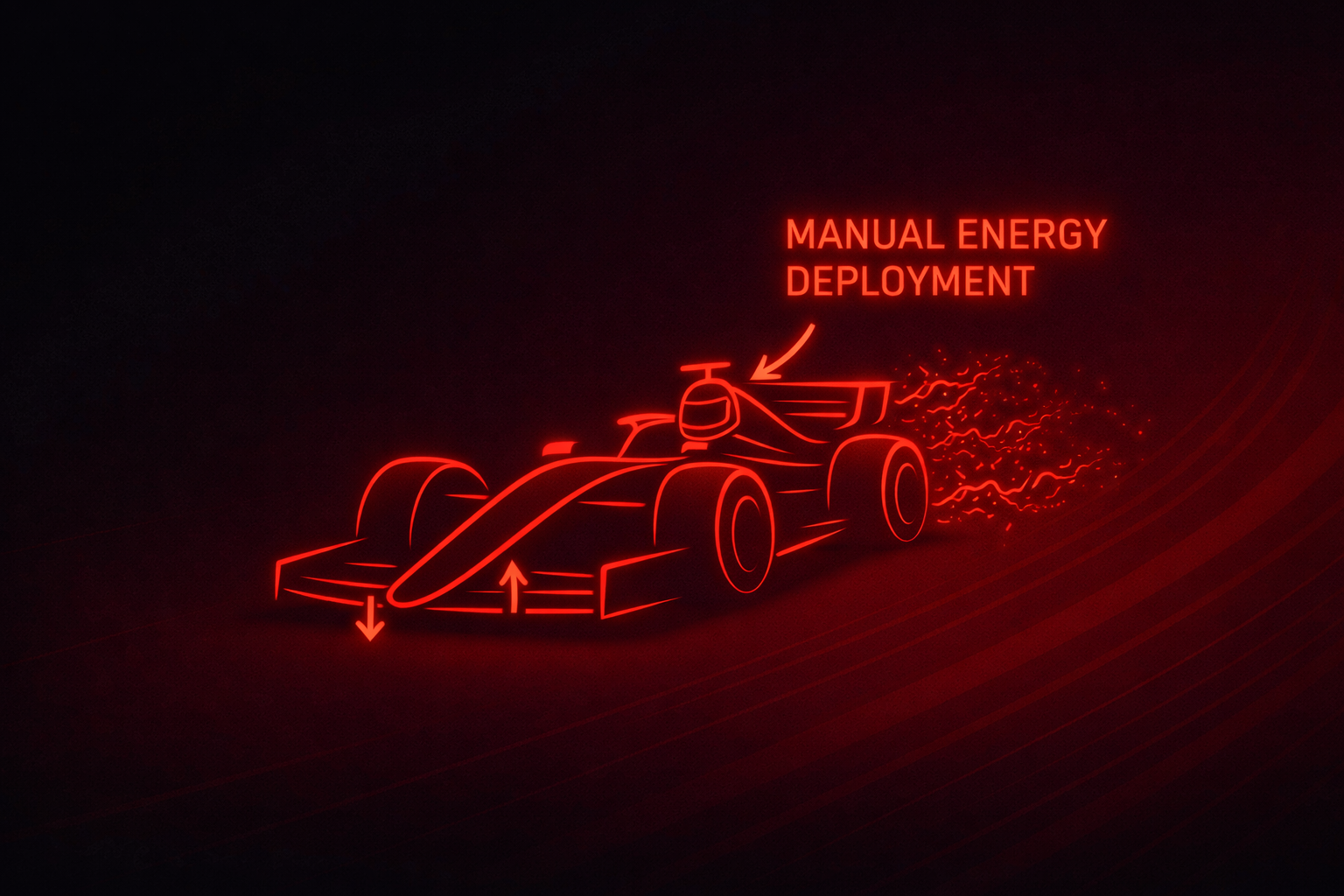
There are races where you can point to a single corner and say, that’s where it turned — not because someone braked later, but because someone spent something they couldn’t get back. A little extra electrical shove on the exit. A slightly earlier lift to bank a bigger harvest. A decision to defend now knowing the tyres will complain 12 laps later. In the 2026 era, energy deployment stops being background noise and becomes a front-row skill: the difference between a pass that sticks and a stint that quietly collapses.
The 2026 shift: overtaking stops being a wing trick and becomes an energy problem
For the last few seasons, overtaking conversations kept orbiting the same gravitational pull: DRS zones, detection points, and whether a straight was long enough to “matter.” In 2026, that framing changes — not because overtaking suddenly becomes easy, but because the sport is reassigning responsibility. DRS is being replaced by Overtake Mode, while manual driver-operated deployment is formalised as Boost Mode. The point isn’t the new vocabulary; it’s the new workload. Passing becomes less about waiting for an activation zone and more about building the right energy state to create a speed delta without paying for it with tyre temperature and traction later.
The technical backdrop is what makes this meaningful rather than cosmetic. The 2026 power unit keeps the V6 architecture, removes the MGU-H, and massively increases the electrical contribution: the MGU-K power rises to 350 kW, and the regulations allow up to 8.5 MJ per lap of energy recuperation under braking. That’s not just “more battery.” It’s more situations where a driver can be wrong — and more situations where a driver can be clever. If you want the broader context of how this ties into the new cars, active aero, and racecraft, it fits neatly alongside our breakdown in Active Aero Explained Without the Hype.
Why manual deployment is a skill, not a setting
When people say “energy management,” it can sound like a spreadsheet problem — the kind of thing a pit wall optimises, then the driver executes. But the reality is messier, and that mess is where driver skill lives. Deployment decisions happen in places where the driver is processing tyre grip that changes corner-to-corner, dirty air that changes lap-to-lap, and traffic that changes sector-to-sector. Boost Mode being driver-operated means the “when” isn’t theoretical; it’s instinct, timing, and restraint.
What makes it hard is that energy isn’t a separate system. It’s glued to everything you care about: brake phase, throttle phase, tyre slip, and track position. Spend too much electrical torque at low speed and you don’t just accelerate harder — you heat the rear tyres, you increase micro-slip, you risk traction control-by-foot, and you move yourself closer to the point where degradation stops being linear and starts being a cliff. Save too much and you might keep your tyres pretty… while gifting the car behind a free DRS-style run (or, in 2026 terms, a perfectly-timed Overtake Mode opportunity).
The three currencies: battery, tyres, and clean air
RaceMate tends to treat races as an exchange rate problem: you’re constantly converting one resource into another. Manual energy deployment adds a sharper conversion rate because it’s immediate and tempting. Battery converts into lap time and track position; tyres convert into stint length and late-race pace; clean air converts into tyre life and energy efficiency because you’re not constantly correcting in dirty air. The skill is choosing which currency to spend when the market is volatile.
A driver who understands this doesn’t just “use boost to attack.” They use boost to avoid tyre damage in traffic by completing a pass quickly, then cashing in clean air. Or they deliberately hold deployment to protect traction in a high-deg phase, knowing that a defensive burst later will be worth more points than a short-lived attack now.
What 2025’s title fight tells us about 2026 energy decisions
The easiest way to understand why this matters is to look at what margins already decide championships — even before the 2026 reset. The final 2025 Drivers’ Championship ended with Lando Norris on 423 points, Max Verstappen on 421, and Oscar Piastri on 410. That’s not a season decided by “dominance”; it’s a season decided by error budget. And McLaren’s 2025 Constructors’ total — 833 points — shows what happens when a team consistently converts strong pace into clean, repeatable results rather than volatile peaks.
Now layer in the 2025+ sporting detail that changes the incentive structure: there is no fastest-lap bonus point from 2025 onwards. That matters more than it sounds. Without a late-race “free point” to chase, the value of a risky stop or a tyre-killing hotlap drops — and the value of defending a single position increases. In a world where P1 vs P2 can swing a championship by two points, manual deployment becomes less about highlight moments and more about banking outcomes. If you want to sanity-check how small finishing-position swings compound across a season (especially under different Sprint weekend assumptions), plug your own scenarios into RaceMate Simulate.
Where deployment creates overtakes — and where it quietly destroys tyres
Not every circuit “prices” energy the same way. The 2026 calendar opens in Melbourne (March 6–8, 2026) and closes in Abu Dhabi (December 4–6, 2026), with energy-demanding stops like Jeddah, Baku, Spa, Monza, Las Vegas, and the new Madrid race in September. The common thread isn’t simply long straights; it’s the combination of (1) braking harvest potential, (2) traction zones where electrical torque can spike tyre slip, and (3) overtaking geometry where a speed delta actually converts into a pass.
Long-straight, big-brake tracks: the “harvest → deploy → defend” loop
Tracks like Baku and Las Vegas are obvious energy theatres because they combine long full-throttle phases with heavy braking zones that refill the battery. That sounds like “lots of energy available,” but it’s a trap: it encourages overuse. If you deploy aggressively every lap, you often arrive at the braking zone at higher speed with slightly higher tyre load and temperature, which can push you into locking risk or a compromised rotation — and then the driver starts sliding on exit, which is where rear degradation begins.
The skilled version of this is selective aggression. You don’t spend battery to be fast everywhere; you spend it to be fast where it changes your race. That might mean one lap of maximal deployment to break DRS/Overtake Mode threat range, followed by several laps of controlled output that keeps the tyre in its happiest temperature window.
High-speed flow tracks: energy is less about top speed and more about stability
On circuits like Suzuka and Silverstone, you don’t “win” by pressing boost on every straight; you win by maintaining platform stability through high-speed direction changes so you don’t scrub the tyres and spike surface temperatures. Here, energy deployment is often about corner exit discipline — avoiding the moment where extra torque encourages a small slide that looks harmless on onboard but costs you for the next 10 laps.
The tactical twist is traffic. When you’re following, dirty air raises tyre temperature and reduces aero efficiency, which can tempt a driver to compensate with electrical power. That can work for a lap. But if you use battery to mask aero loss, you often end up with both problems at once: you’re still in dirty air and now you’ve heated the tyres. This is where patience becomes pace.
Street circuits: traction is the limiter, not horsepower
Street tracks don’t forgive “free power.” Low-speed exits are where the rear tyres either survive or start dying early. Manual deployment is therefore a tyre management tool as much as an overtaking tool: the best drivers treat boost as something you earn with clean rotation, not something you demand from the car. If you want a parallel from the current era’s overtaking logic, it’s the same principle we mapped in Overtaking in 2025: Where DRS Helped — and Where It Didn’t: the pass is usually decided by the setup laps, not the lunge.
Boost Mode vs Overtake Mode: two buttons, two very different mistakes
RaceMate’s simplest framing for 2026 is this:
- Boost Mode is always a temptation. It’s driver-operated maximum deployment — useful for attacking, defending, or even stabilising lap time when tyres fade.
- Overtake Mode is situational permission. It’s available when you’re within one second at the detection point, and it’s designed to manufacture a more reliable passing chance than “wait for DRS and hope.”
The classic Boost Mode mistake is obvious: using it too often, too early, and turning a long run into a short one. The more subtle mistake is using it in the wrong phase. Boosting mid-corner is rarely the point; boosting on exit is. But boosting on exit when the rear is already marginal doesn’t just cost you traction — it costs you tyre life and can force you into an earlier stop. And once you’re early, you’re vulnerable to the same strategic traps we outlined in The Pit Stop Window Explained: When “Too Early” Becomes “Too Late”.
Overtake Mode’s mistake is different: believing it guarantees a pass. It doesn’t. It gives you a better chance — but only if the driver has built a battery state that allows them to use it without arriving at the next braking zone defenseless. The best defenders will force attackers into spending energy to get alongside, then punish them one lap later when their deployment profile is empty and their tyres are hotter.
Championship implications: the 2026 reset makes the driver’s decisions louder
Regulation resets don’t just shuffle pace; they shuffle what matters. In 2025, McLaren won the Constructors’ Championship with 833 points, followed by Mercedes (469), Red Bull (451), and Ferrari (398) — a spread that tells you the top team wasn’t just quick, it was consistent. In 2026, consistency is still king, but it may be achieved differently: with higher electrical power and more driver-operated tools, teams that best train drivers to “spend energy like it’s tyre life” can steal results even when their baseline pace isn’t best.
That’s why manual energy deployment is poised to become a signature differentiator. It rewards drivers who can think two laps ahead while racing wheel-to-wheel in the present. It rewards pit walls that can give instructions that fit what the driver is feeling. And it rewards discipline — because the new era will hand drivers more ways to win a battle and lose the war.
RaceMate takeaway: energy is the new racecraft tax
Energy deployment isn’t replacing driver skill; it’s re-pricing it. The best drivers in 2026 won’t just be the ones who brake late or commit early — they’ll be the ones who understand that every burst of electrical power has a shadow: tyre temperature, stint length, vulnerability on the next lap, and the points you didn’t score because you had to pit early. If you want to explore how that plays out over a season — especially with 2025+ scoring removing the fastest-lap bonus — run your own what-ifs in RaceMate Simulate and see how quickly one “small” deployment mistake can turn into a championship-sized problem.