
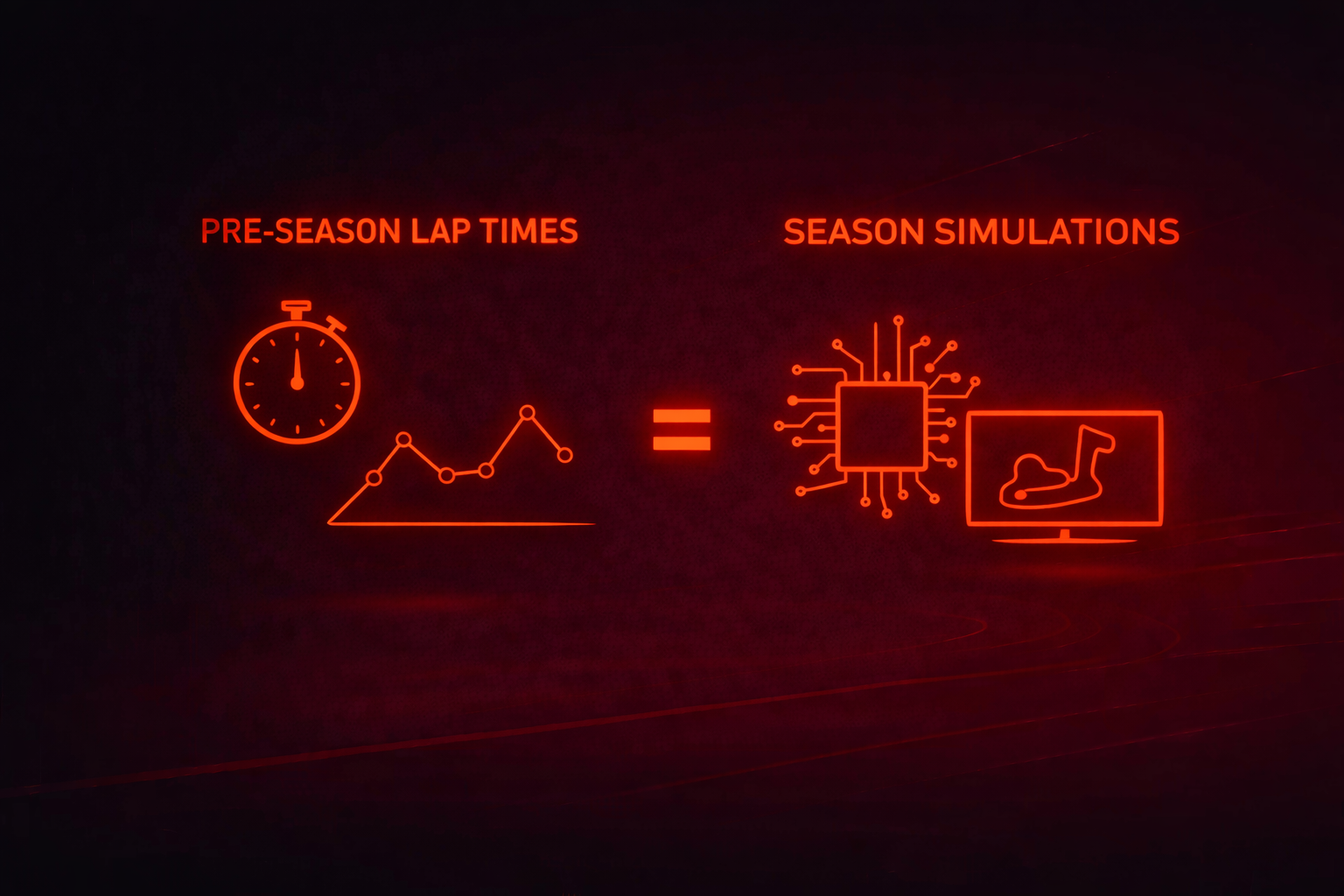
TL;DR
- Pre-season lap times aren’t a standings forecast. They’re a noisy snapshot taken under unknown fuel, tyres, engine modes, and run plans.
- Four big distortions: fuel/compound uncertainty, engine mode choice, run plan (qualifying sim vs long run), and the tiny sample size vs a 24-race season.
- Simulators earn their keep by capturing what testing can’t: conversion, reliability, weekend structure, and development rate.
- Run three scenarios in the Season Simulator — genuinely fastest, top-three compressed, and long-run strong but one-lap average — and compare distributions before committing to a “favourite.”
Pre-season testing is the most over-interpreted dataset in Formula 1.
It’s the first time new cars run meaningful mileage and the first measurable number people see — so they anchor on it. But a championship isn’t awarded for the fastest Thursday in February. It’s awarded for accumulating points across a full season of reliability swings, mid-season upgrades, track-specific strengths, and the variance that F1 always delivers.
A good simulator is useful here not because it “calls” the season, but because it translates noisy pace signals into decision-relevant ranges. If you’re trying to answer high-intent questions — who’s the favourite, how many DNFs can a driver afford, what if the second-fastest car is also the most reliable — you want a tool that models outcomes, not a headline that names them. Start by running your own scenarios in the Season Simulator.
Why testing times don’t map cleanly to points
A single best lap from testing flattens a multi-dimensional performance picture into one number. At a race weekend, at least you can see qualifying sessions, tyre allocation, parc fermé, and a competitive context. In testing, teams are actively hiding information — sometimes deliberately, often just because their program isn’t designed to set a representative lap.
The core issue is that testing laps mix pace (how fast the car can go) with intent (what the team is trying to learn). Championship outcomes depend on repeating point-scoring performances across many events, converting Saturdays into Sundays, and surviving the mechanical and operational attrition that eventually appears when you run at the limit.
A season simulator is built for that gap. It treats pace as one driver of results and forces you to account for the things testing can’t cleanly show — variance, reliability, and development trajectory.
The four biggest distortions in pre-season lap times
1. Fuel load and tyre compound uncertainty
The simplest explanation is also the most powerful: you rarely know how much fuel is in the car, and that one unknown is often big enough to swamp real performance differences. Add tyre compound ambiguity — and the fact that teams use tyres differently, from warm-up prep to number of prep laps to run timing — and the fastest lap becomes a low-confidence indicator.
A testing lap time is best treated as a constraint (“this car is not catastrophically slow”) rather than a ranking (“this car will lead the championship”). That’s why the honest move is to input a pace range into the Season Simulator rather than a single number, and watch how outcomes change across it.
2. Engine modes and “safe” vs “sharp” operation
Testing programs often prioritise correlation and reliability over peak output. Conservative engine modes. Components being protected. Cooling margins being validated with bodywork that won’t appear in qualifying. Some teams will do short aggressive runs to validate a concept, then disappear back into baseline work for days. Others won’t show peak pace at all until the first qualifying session of the year.
From a modelling perspective, peak lap time can be less informative than repeatability. In the simulator, reflect this by giving a car slightly lower ultimate pace but higher consistency (smaller race-to-race variance) and comparing it with a higher-peak, higher-variance alternative. That comparison alone often reshapes your read of the testing week.
3. Run plans — long-run degradation vs one-lap optimisation
One team is mapping tyre degradation on heavy fuel. Another is validating aero changes. A third is practising pit-stop procedures. A fourth is running a qualifying simulation on new softs at the end of the day. These aren’t comparable programs, and the differences matter — championships are decided by teams that can manage tyres and strategy across stints, not by the team that produces one clean lap in ideal conditions.
Separate one-lap pace and race pace as distinct inputs. If your simulator takes a single “pace” number, treat it as race-relevant pace and keep the testing headline lap in its proper place — a noisy hint, not a prediction.
4. Sample size — the season has 24 experiments, testing has a handful
Even if testing were perfectly representative, one lap is still a tiny sample. Championship points accumulate across many weekends, each with its own track traits, weather, Safety Car probability, and operational outcome. That volume is why simulation is a better fit than argument. It can answer questions like “if Car A is usually faster, how often does Car B still win the title?” — and the honest answer is rarely “never,” because variance and DNFs exist.
What a simulator captures that testing can’t
A season simulation’s value is that it models the mechanisms that turn pace into points:
- Conversion. How often a quick car becomes a front-row start, and how often a front-row start becomes a podium.
- Reliability and incident rate. Points lost to DNFs, penalties, contact, mechanical issues.
- Weekend structure. Sprint weekends add points and risk surfaces.
- Development curve. Which team improves fastest, and whether upgrades are consistent or volatile.
You don’t need to know the true testing fuel loads for a simulator to be useful. You just need to be explicit about assumptions, then watch how sensitive the standings are to those assumptions.
Run the same “Team X is quickest” input twice — once with elite reliability, once with merely average reliability. If the title odds swing dramatically between those two worlds, the testing headline was always the wrong anchor.
A workflow for turning testing impressions into scenarios
The point isn’t to force false precision. It’s to move from one story (“fastest lap wins”) to several testable scenarios you can compare.
Define three pace scenarios instead of one.
Scenario A — testing leader is genuinely fastest. Give the car the strongest baseline pace, normal variance. Then check what reliability level is actually required for a comfortable title.
Scenario B — top three within a tenth, track-dependent. Compress the pace gap and raise the role of variance. This is usually where strategy, qualifying execution, and incident rates become decisive.
Scenario C — long-run car is strong on Sundays, not Saturdays. Reduce qualifying strength relative to race strength. These seasons tend to produce shared wins, championships decided by damage-limitation weekends, and tighter final standings than the headlines suggest.
Put each into the Season Simulator and compare the distribution of outcomes: expected points, median championship position, spread between the 25th and 75th percentile. A driver with a strong median but a wide spread is a high-uncertainty profile, which is useful to flag early.
Reading outputs without treating them as predictions
A season simulator is only as good as its assumptions — but it’s still more honest than a single testing time, because it tells you how the assumptions translate into outcomes.
Three questions to focus on when you read the results:
- What’s driving the result? If the model is giving a team a huge advantage, check whether it’s coming from pace, reliability, or development rate. That tells you what you implicitly believe, and where you should stress-test.
- How fragile is the conclusion? If small changes to DNF rate or pace variance flip the title, treat the season as wide open even if one testing lap looked dominant. Fragility is data.
- What does “likely” actually mean? A 60% title probability isn’t certainty. It’s a statement about the model under a specific set of inputs, with the remaining 40% living in real risk — reliability tails, bad strategy weekends, operational errors. In F1, tail risks are always real.
One rules note: from 2025 onwards there’s no fastest-lap bonus point. That removes a small but meaningful lever that used to reward late-race tyre gambles, and slightly reduces the number of marginal strategy branches you need to consider when translating pace into points.
The takeaway
Pre-season testing is useful — but not because it reveals the standings. It’s useful because it gives you enough information to define plausible pace tiers and ask better questions. Season simulation is where you convert those questions into structured scenarios, quantify uncertainty, and avoid overcommitting to the loudest lap time of the week.
If you want an answer you can actually act on, run your assumptions — plural — in the Season Simulator. The value isn’t picking the one correct narrative in February. It’s understanding which inputs would need to be true for that narrative to survive a full season.