
TL;DR
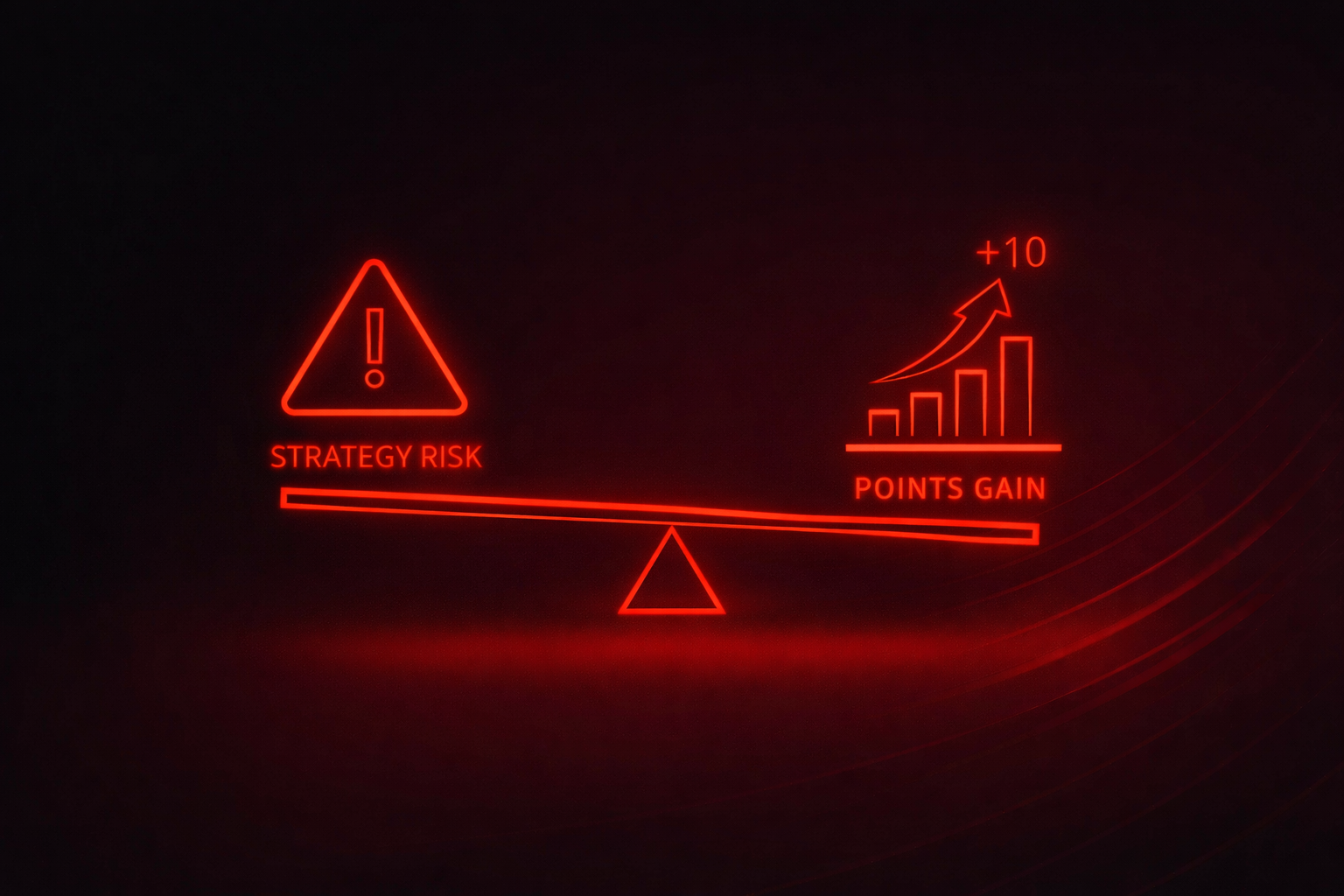
- Aggressive strategies usually widen the range of outcomes — more upside and more downside — without actually raising the average points you’d expect.
- The mean and the spread are two different answers. Reading strategy like a distribution stops you from confusing volatility with value.
- Four things amplify variance: traffic after the stop, degradation error, Safety Car timing, and tyre warm-up on the outlap.
- Run the tradeoff in the Tyre Strategy Simulator, nudge one assumption at a time, and choose the plan whose distribution matches what the race (or the championship) actually needs.
A bold undercut wins on Sunday and the timing screen crowns it “the right call.” It usually wasn’t. The call was one path through a tree of possible outcomes, and the race rolled a good one. Run the same decision a hundred times against slightly different traffic, Safety Car timing, and degradation, and you’ll find a lot of the aggressive calls that look brilliant in highlight clips are closer to coin flips than strategic masterstrokes.
Strategy is a decision under uncertainty. You don’t pick the outcome — you pick a distribution of outcomes. The useful question isn’t “can this win?” but “does this plan improve our expected points by enough to justify the extra downside?”
A good simulator makes that tradeoff visible. It doesn’t pick a hero plan for you. It tells you how much of each strategy’s success depends on things that aren’t in your control — traffic after the stop, whether a Safety Car lands in your window, whether degradation is half a tenth worse than the model thought. Run the comparisons in the Tyre Strategy Simulator and look for two numbers every time: expected points, and spread.
Aggressive usually means “more sensitive”
In strategy talk, “aggressive” tends to mean any plan that leans harder on a specific assumption being right for long enough. That could be:
- An earlier stop to attempt an undercut.
- Stretching a stint to create a Safety Car window.
- Committing to a softer compound that needs clean air to work.
- Dropping a stop to save pit loss.
None of those are good or bad in the abstract. What they have in common is that they raise the stakes on one variable being correct. That’s what separates them from a conservative call, which is usually designed to survive across many worlds rather than win in one specific one.
The important distinction: aggressive calls can raise your ceiling without raising your expected finish. The best case gets better. The mean barely moves. And the tails get fatter — both of them. That matters because points are nonlinear. A small probability of losing four positions can easily erase the value of a small probability of gaining two. A DNF on the back of a strategy gamble wipes out a season’s worth of clever undercuts.
This is sharper now that the fastest-lap bonus is gone (2025 onwards). One of the classic “free roll” incentives for a late stop has been taken off the table. A late soft-tyre stop to grab the bonus used to carry positive expected value on its own. Without it, the same stop is almost always defensive or position-focused. Strategy now skews less towards stealing an extra point and more towards protecting the distribution you’ve already got.
A simulator gives you two numbers, not one
Stop asking the Tyre Strategy Simulator which strategy is “best.” Start asking it for two numbers per strategy:
Expected points. The average across many plausible evolutions of the race.
Variance. What the best and worst outcomes look like when the uncertain inputs move against you.
Set a baseline strategy — something that would feel normal for your starting position and the car’s pace. Then create an aggressive alternative that goes after track position. The moment you compare the two, you’ll see a pattern that keeps showing up: the aggressive plan produces more extreme results (bigger gains, bigger losses), while the average stays in the same neighbourhood unless one specific assumption really is in its favour.
That’s not the tool being indecisive. That’s the honest shape of strategy. You’re not picking the right answer — you’re picking which distribution you want to buy.
Where variance actually comes from
Variance isn’t random noise. It’s the output of a handful of mechanisms that compound small errors into big ones.
Traffic after the stop. This is the undercut’s dirty secret. In a clean-lap model, the earlier stop looks like an obvious gain. In real races, if the new tyres come out behind a slower car for three laps, the tyre advantage is burned for zero net movement. The expected value of the call depends less on the tyre delta and more on how likely you are to land in clean air. That’s not a fixed number — it depends on the field around you, the pit cycle, and how bunched the pack is.
Degradation being slightly wrong. Every strategy is built on a degradation slope that’s estimated, not measured. If your model is wrong by even a tenth per lap, the error compounds across a 20-lap stint. This is why soft-heavy plans usually have a wider spread. They’re more exposed to the slope being half a tenth worse than expected — the kind of error that’s inside your measurement noise.
Safety Car and VSC timing. A strategy that only wins when a neutralisation lands in your window isn’t necessarily bad, but it’s high-variance by definition. The expected value has two inputs: how likely a neutralisation is, and whether it arrives during the laps where it helps. “We need a Safety Car between laps 18 and 25” is betting on timing, not probability. The historical SC rate at a track tells you something; the timing distribution tells you more.
Outlap and warm-up behaviour. Even when the steady-state tyre is faster, the first lap out of the pits can be awful. Compounds with bad warm-up create a short-term vulnerability that any aggressive plan relying on passing slower cars immediately is exposed to. If your simulator models outlap pace, you’ll see this cost — a plan that looks great on lap-average time might bleed positions in the first two laps out of the pits.
The thing people underrate is that these are correlated risks. When traffic goes wrong, tyre life goes wrong (because you’re pushing to pass). When tyre life goes wrong, the next decision gets harder (defend or pit again). Aggressive plans don’t just add risk — they add risks that feed each other.
How to actually run it
Use the Tyre Strategy Simulator the way a race engineer would build a pre-race model.
Set your baseline first. Something robust — reasonable tyre-life margins, flexible pit windows, not overly dependent on any one assumption. Then build an aggressive alternative: earlier undercut, longer first stint for an overcut window, softer compound choice. You now have two strategies to compare.
Then do the part most fans skip: move the assumptions.
- Nudge degradation slightly worse than expected. If the aggressive plan falls off a cliff while the baseline just loses a few seconds, that’s your signal — the aggressive plan’s success is conditional on being right about the slope. Not automatically wrong, but the downside is now priced in.
- Change the traffic picture. Run “clean air after stop” and “stuck behind a slower car for three laps” as two separate worlds. Aggressive undercuts usually look excellent in the first and mediocre-to-bad in the second.
- Vary Safety Car likelihood and timing. If the aggressive plan only wins when the SC lands in a narrow window, you’re buying volatility rather than mean points.
- Translate the finishing ranges into points. Debates stay in seconds because it feels precise, but championships are scored in points. A plan that nudges your P7 probability up while occasionally dropping you to P12 is often negative expected value in points, even if it sometimes produces a flashy P5.
If you want the single-race decision to connect to title dynamics, push your strategy’s typical finishing range through the Season Simulator. That’s where small weekly variance compounds across a calendar — or flattens out, depending on what you chose.
”Best strategy” depends on what you’re trying to buy
When a simulator flags a strategy as “best,” check what it’s optimising for.
Highest expected points is the default. It’s also sometimes the wrong target. If you’re defending a championship lead, the downside tail matters more than a small gain in the mean — a plan with a slightly lower average but a much tighter spread is probably the one you want. If you’re chasing in the standings, the opposite is true: you need upside, so a high-variance plan can be rational even though it also increases your chance of a worse Sunday.
This is what decision-led use of a tool looks like. You’re not asking the simulator what will happen. You’re asking it to quantify what you’re choosing — a distribution with specific properties — and then picking the one whose shape fits your objective.
The useful version of a strategy debate sounds like: “Plan A and B have similar expected points, but A has a tighter spread and B creates more swing outcomes. Given where we are in the standings, we want the tighter spread.” That’s not a hot take. That’s a decision you can defend.
The takeaway
Aggressive strategies aren’t smarter by default. Conservative ones aren’t safer by default. What simulators expose is the real trade: most aggressive calls primarily increase variance, not expected value. Sometimes that’s exactly what the weekend needs. Often it’s a hidden cost.
Stop asking which strategy wins. Ask which distribution you want to buy. Run it in the Tyre Strategy Simulator, stress one assumption at a time, and choose the plan whose upside and downside actually match what the race (or the championship) is asking for.