
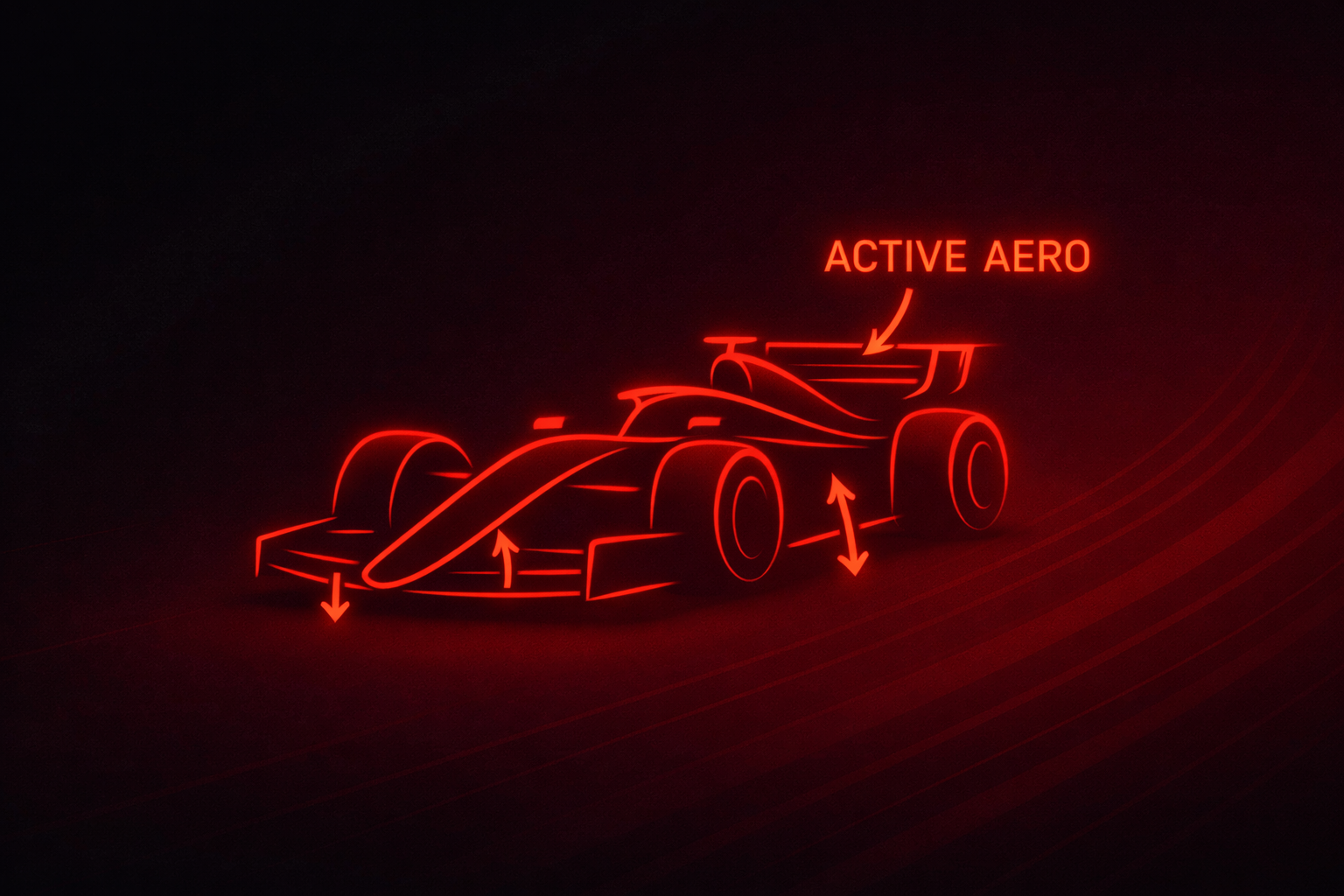
There’s a temptation to treat active aero like a cheat code — a future button that turns straights into drag strips and corners into qualifying laps. But the interesting part of 2026 isn’t that wings move; it’s when you choose to move them, what you sacrifice to do it, and how quickly the car stops feeling ‘stable’ when you ask it to change its aerodynamic personality mid-lap. In other words: active aerodynamics won’t delete racecraft. It’s going to re-price it.
What active aero actually is in 2026 (and what it isn’t)
Let’s clear the fog first, because ‘active aero’ is being used as a catch-all phrase.
In 2026, Formula 1’s cars are set to run movable front and rear wing elements that can switch between two configurations: a higher-downforce state (commonly referred to as Z-mode) and a lower-drag state (X-mode) intended to increase straight-line speed. Drivers manually activate the system in defined zones, and it behaves a bit like modern DRS in operation (open on straights, close under braking/lift), but with a critical shift in philosophy: opening the wing is no longer only an overtaking tool. It’s a lap-time tool, every lap, for every car.
That’s why the hype misses the point. If everyone gets the low-drag configuration in the same zones, the advantage doesn’t come from having it — it comes from using it better.
And importantly: 2026 is also framed as a reset for the overall car concept (smaller, lighter, lower drag, reduced downforce). The FIA’s headline targets include a lower minimum weight and significant reductions in downforce/drag, which means the new cars are expected to be more sensitive to balance shifts — exactly the kind of sensitivity active aero can amplify if you’re sloppy with timing.
Active aero vs DRS: the key racecraft difference
DRS created a very specific kind of racing: a detection line, a one-second threshold, and a predictable ‘slingshot’ phase where the car behind often had the best of the straight.
Active aero changes the incentives:
- More drivers will arrive at braking zones with less drag (because X-mode isn’t reserved for the car behind).
- The advantage shifts toward corner-exit quality and energy management, because straight-line speed becomes more ‘equalised’ by design.
- The pass attempt becomes less about a single flap opening and more about sequencing: exit, deployment, line choice, braking commitment, then traction.
The hype version says: ‘no more DRS trains.’ The realistic version says: different trains, different uncoupling points.
Corner entry: where active aero quietly changes everything
Corner entry is where modern F1 drivers already make time (and avoid losing it). You’re braking at the limit, often turning in while shedding speed, with aero load bleeding away as the car slows. Now add a new variable: your car may be transitioning from a low-drag configuration into a higher-downforce one right before (or during) that phase.
If the system closes automatically on braking/lift (as currently described), that transition is effectively a moving aero balance event that you need to anticipate — not react to.
That matters because:
- Brake stability is aero stability. A small front/rear load shift changes how much entry rotation you can ‘ask for’ without locking or snapping.
- Confidence is lap time. Drivers who can consistently commit to a late brake point while the aero platform is changing will look ‘braver’ — but it’s really repeatability.
- Defence gets harder to fake. In the DRS era, you could sometimes defend by simply ensuring the car behind didn’t get a clean run into the activation zone. In 2026, the car behind may still have X-mode, so the decisive moment shifts toward the braking phase itself.
Expect teams to talk a lot about platform control again — ride, pitch sensitivity, and how predictable the car feels as it transitions between configurations.
The 2026 car concept makes entry timing more punishing
The FIA’s stated aim for 2026 includes smaller dimensions and reduced mass, alongside the aerodynamic/power unit overhaul. That’s a recipe for cars that change direction more willingly — and punish micro-errors more quickly because you’re carrying less ‘inertial forgiveness’ and working with a different downforce-to-drag trade.
In practical terms, this could increase the value of:
- Front-end confidence on turn-in (especially in medium-speed corners where you’re tempted to keep more aero ‘open’ longer)
- Consistent braking traces (less time lost to corrections)
- Predictable engine braking and energy recovery mapping (because you’re trying to arrive at apex with both balance and battery state under control)
Corner exit: traction, deployment, and why the ‘best pass’ starts earlier
The exit phase is where active aero becomes less visible — and more decisive.
If X-mode reduces drag on the straight, then the quality of your run onto that straight becomes more valuable, because the speed you carry is amplified by lower resistance. That puts a spotlight on classic exit fundamentals:
- minimum-speed discipline
- throttle timing
- rear tyre temperature control
- steering unwinding (to reduce slip)
But 2026 isn’t only aero. The regulations are also designed around a very different hybrid usage profile (more electrical emphasis) and a renamed set of driver tools — including Overtake Mode (extra electrical energy when within a defined gap) and Boost (a maximum power button, subject to available charge).
So the post-2026 overtake is less likely to be ‘DRS made me faster’ and more likely to be:
- I got a better exit because my car stayed stable through the mode transition.
- I positioned to force the defender to choose a compromised line.
- I used the right amount of electrical deployment at the right moment.
- I arrived at the braking zone with enough control to finish the job.
That’s racecraft — but with a different spreadsheet behind it.
Defending in the active aero era: the end of easy answers
Defending in modern F1 is often a game of managing where you are vulnerable. You’ll hear drivers talk about ‘compromising the entry to protect the exit’ or ‘giving up the apex to own the traction.’
Active aero should make those choices sharper.
Because X-mode is expected to be available for defined zones (with discussion suggesting it could apply to any straight long enough to justify it), you can’t rely on simply ‘not giving DRS.’
Instead, defenders may lean into three levers:
- Line ownership earlier in the lap: placing the car so the attacker’s best exit is harder to achieve.
- Energy denial: forcing the attacker to deploy early (and run out before the braking zone) or lift to avoid dirty air.
- Braking theatre that actually matters: showing the car in the mirror late enough to disrupt the attacker’s confidence without crossing into penalty territory.
The attacker, meanwhile, will be hunting for a new kind of ‘trigger’: not the DRS activation, but the moment the defender has to close the aero, stabilise the car, and commit to a braking point. That is a more human moment than a flap zone — which is exactly why this might improve the spectacle.
Will this reduce overtakes?
It might reduce the ‘free’ ones.
If the straight-line delta is less artificially skewed toward the car behind, you may see fewer passes where the outcome is decided by halfway down the straight. But you can also see more real fights if cars can follow better and arrive at braking zones closer, with fewer aerodynamic wash effects.
RaceMate’s bet: fewer autopilot moves, more multi-corner pressure.
The circuit effect: where active aero should matter most in 2026
The 2026 calendar is set to remain at 24 races, beginning in Melbourne on March 6–8, 2026, and ending in Abu Dhabi on December 4–6, 2026, with Madrid joining as a new venue on September 11–13 (subject to homologation).
Active aero won’t hit every track the same way. The ‘X-mode value’ rises with straight length and with how sensitive the lap is to drag.
High-impact active aero circuits (likely)
Expect the biggest tactical swings where straight-line time is a major portion of lap time:
- Monza: low-drag philosophy already rules here, so mode transitions and deployment timing become the battleground.
- Baku: long full-throttle sections plus heavy-braking corners — a perfect environment for exit-to-brake sequencing.
- Jeddah and Las Vegas: high-speed commitment, where stability during transitions can decide confidence.
Lower-impact active aero circuits (still important)
On tracks where corners dominate:
- Monaco and Hungary likely compress the advantage because there’s less straight to monetise, which shifts the focus back to mechanical grip and confidence.
This is why active aero should be discussed as a circuit-specific tool, not a universal overtaking cure.
Why the points context still matters (and why 2025 was the warning shot)
Active aero is a 2026 story — but the championship stakes are already written in 2025 ink.
The 2025 Drivers’ title was decided by two points: Lando Norris finished the season on 423 to Max Verstappen’s 421, with Oscar Piastri on 410. In the Constructors’, McLaren ended on 833, ahead of Mercedes (469), Red Bull (451) and Ferrari (398).
And remember: there is no fastest lap bonus point from 2025 onwards, which means marginal gains have fewer ‘gimmie’ recovery routes — you can’t paper over a messy Sunday by grabbing a late extra point. In that world, every position swing created by better mode timing, better exit discipline, or smarter defence becomes championship material.
If you want to feel how small margins explode over 24 rounds, run your own what-ifs in the RaceMate championship simulator — it’s the quickest way to turn ‘that one overtake’ into actual points gravity.
What to watch for in early 2026: the telltale metrics
Pre-season takes will over-index on lap time, because that’s what we do. But active aero will leave fingerprints you can track even when the fuel loads are unknown.
Here are the early indicators that matter more than headline P1s:
- Mode discipline: who looks stable at the end of long straights when the car transitions back to high downforce.
- Exit quality under pressure: who keeps traction while following closely (dirty air is still a thing; it’s just priced differently).
- Defence success rate: not just ‘did they keep the place,’ but how much battery did it cost them to do it.
- Overtake sequencing: who can threaten without spending everything at once.
This is also where your 2025 context helps. If you enjoyed the way strategy evolved last season, the active aero era is essentially strategy moving from pit wall timing into driver timing — a shift we’ve been tracking across our recent analysis pieces like 2025 Season Review Through a Strategy Lens and Overtaking in 2025: Where DRS Helped — and Where It Didn’t.
Conclusion: active aero won’t replace racecraft — it will expose it
The cleanest way to think about active aero is this: it doesn’t add a new superpower. It adds a new responsibility.
When every driver can access a low-drag configuration, the sport stops rewarding the simplest mechanic (get within one second, press button) and starts rewarding the hardest one: building the overtake across multiple phases without breaking the car’s balance, the tyres, or the battery plan. Corner entry becomes a test of composure during aero transitions. Corner exit becomes a test of discipline. Defending becomes less about ‘breaking DRS’ and more about controlling the attacker’s options.
If the hype promised a revolution, the reality is better: a quiet redesign of what ‘good driving’ looks like — and a new layer of measurable, data-driven racecraft that RaceMate can actually model.
If you’re already thinking in championship deltas rather than highlight clips, you’re ready for 2026. And if you’re not? Active aero will teach you the hard way.