
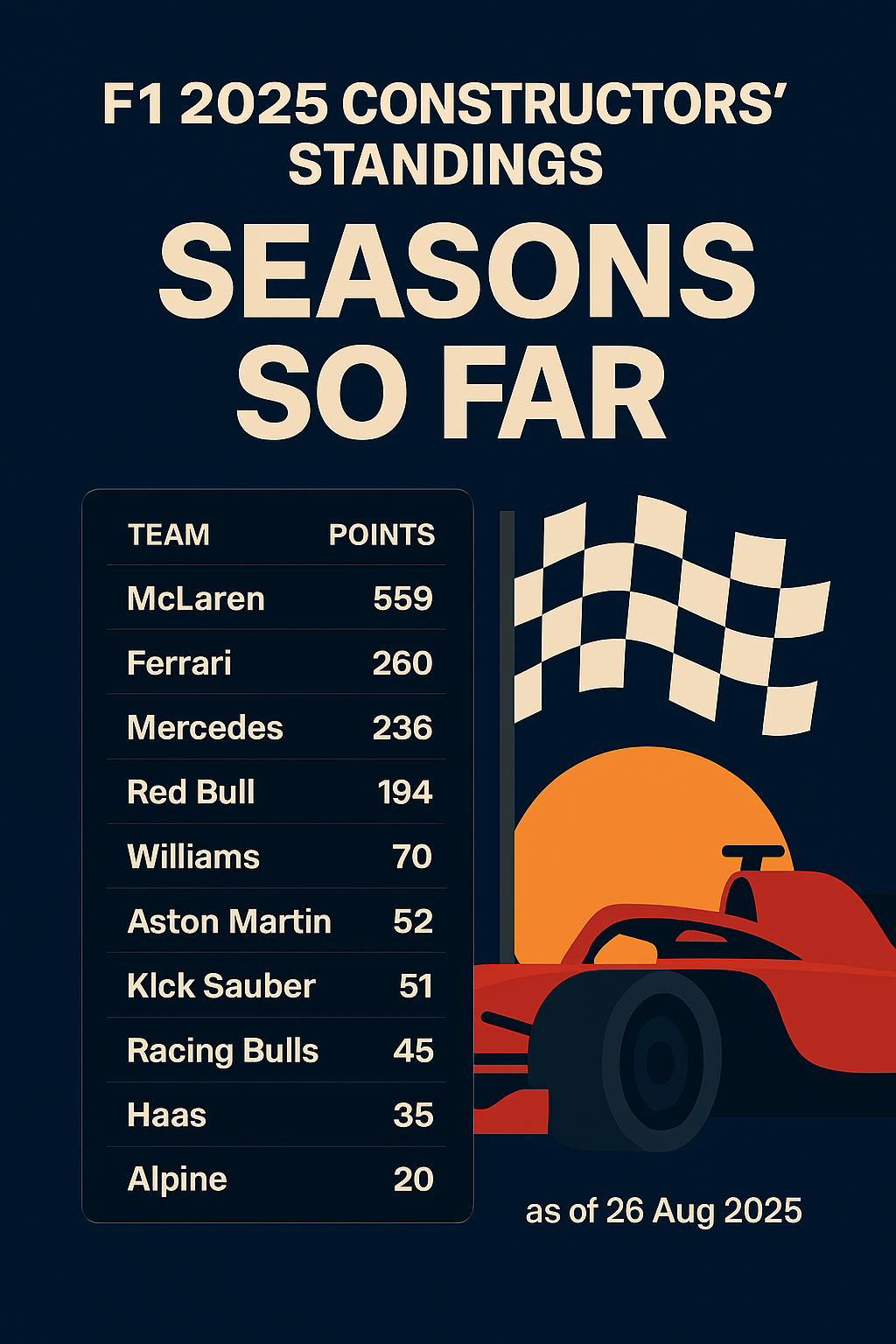
The 2026 Formula 1 season marks the biggest regulation overhaul in a generation. New power units, radically redesigned cars and active aerodynamics have reshuffled the competitive order. This page tracks the F1 2026 constructors’ standings throughout the season — bookmark it and check back after every race weekend for the latest points, gaps and analysis.
How the F1 points system works in 2026
The F1 points system carries over from recent seasons. Grand Prix finishing positions earn 25 points for a win, 18 for second, 15 for third, then 12–10–8–6–4–2–1 down to tenth. An extra point is awarded for the fastest lap, provided the driver finishes in the top ten. Sprint races at selected weekends award 8–7–6–5–4–3–2–1 for the top eight. All points — race, sprint and fastest lap — count towards the constructors’ championship.
When races are shortened due to weather or incidents, reduced points are awarded based on the percentage of scheduled distance completed. For a detailed breakdown, see our explainer on standings in shortened races. Tie-breakers favour the team with more race wins, then more second-place finishes, and so on.
What changed for 2026
The 2026 regulations represent Formula 1’s most ambitious reset since the hybrid era began in 2014. Key changes affecting the constructors’ battle:
-
New power units: The internal combustion engine shrinks from 1.6 litres to a more electrically biased hybrid. Electrical power output roughly triples, making up close to half of total power. The MGU-H is removed, simplifying the power unit but placing greater emphasis on energy deployment strategy.
-
Active aerodynamics: Cars feature moveable aerodynamic surfaces for the first time in decades. A low-drag mode activates on straights, while high-downforce configurations engage in corners. This fundamentally changes how teams approach car design and race strategy.
-
Lighter, narrower cars: The minimum weight drops and car width is reduced, aiming for more agile machines that can follow and overtake more easily.
-
New engine manufacturers: Honda returns as a works supplier with Aston Martin, while Audi enters as a full constructor having completed the Sauber takeover. Cadillac joins as the eleventh team on the grid. These new entrants expand the field and bring fresh competition.
Current F1 2026 constructors’ standings
After two rounds — the Australian and Chinese Grands Prix — the new regulations have already produced a clear early leader. Mercedes have stormed to the front with back-to-back one-two finishes, echoing the dominance they showed when the hybrid era began in 2014. The table below shows the standings accurate as of 15 March 2026 (after Round 2, the Chinese Grand Prix):
| Position | Team | Points | Gap to leader |
|---|---|---|---|
| 1 | Mercedes | 98 | — |
| 2 | Ferrari | 67 | 31 |
| 3 | McLaren | 18 | 80 |
| 4 | Haas | 17 | 81 |
| 5 | Red Bull | 12 | 86 |
| 6 | Racing Bulls | 12 | 86 |
| 7 | Alpine | 10 | 88 |
| 8 | Audi | 2 | 96 |
| 9 | Williams | 2 | 96 |
| 10 | Cadillac | 0 | 98 |
| 11 | Aston Martin | 0 | 98 |
Mercedes’ 31-point lead over Ferrari already looks significant, but it is early days. With twenty rounds still to race, the standings will shift as teams bring upgrades and learn the new regulations. Red Bull and Racing Bulls are tied on 12 points, while Haas are a surprise fourth — ahead of both Red Bull and the defending champions McLaren. At the bottom, Cadillac and Aston Martin are yet to score.
This table is updated after every race and sprint session throughout the 2026 season.
Team-by-team analysis
Mercedes: the early benchmark (98 points)
The Silver Arrows have made the strongest possible start. George Russell won the season opener in Australia, with Kimi Antonelli completing a one-two — then Antonelli took victory in China with Russell second. Two races, two one-two finishes, 98 points. It is a stunning echo of 2014, when Mercedes’ superior understanding of the new hybrid regulations gave them a dominant advantage from day one. The Mercedes power unit appears to be the class of the field once again, and the team’s grasp of active aerodynamics looks ahead of the competition. The question is whether rivals can close the gap as they learn the new rules, or whether Mercedes will run away with it.
Ferrari: best of the rest (67 points)
Ferrari are the only team within realistic striking distance of Mercedes so far. Charles Leclerc took third in Australia, showing the SF-26 has pace, and Lewis Hamilton finished third in China. With 67 points from two rounds, Ferrari are clearly the second-fastest team, but the 31-point deficit is already a concern. Hamilton’s second season at the Scuderia should bring a more settled partnership with Leclerc, and Ferrari’s in-house power unit gives them a development path independent of any supplier. Upgrades will be critical — Ferrari need to find the performance to challenge Mercedes on Sundays, not just qualify close.
McLaren: a humbling reset (18 points)
The defending constructors’ champions have been brought back to earth. After dominating 2025, McLaren sit third with just 18 points — 80 behind Mercedes. The regulation reset has exposed how much of their 2025 advantage was tied to the old aerodynamic rules. The team’s engineering depth means they should improve as the season progresses, but for now they are battling in the midfield rather than at the front. A long development road lies ahead.
Haas: the surprise package (17 points)
The biggest shock of the early season. Haas sit fourth in the constructors’ championship, just one point behind McLaren and ahead of both Red Bull and Racing Bulls. Under Ayao Komatsu’s leadership and with the Ferrari power unit, the American team appear to have nailed key aspects of the new regulations. Whether they can sustain this form as bigger teams bring upgrades remains to be seen, but it is a remarkable start.
Red Bull: finding their feet (12 points)
Red Bull’s first season with their own power unit has been a struggle. Tied on 12 points with Racing Bulls, the team that won four consecutive constructors’ titles (2022–2023) finds itself fifth. Max Verstappen continues to extract everything from the car, but the Red Bull Powertrains unit appears to lack both performance and reliability compared to established manufacturers. Building a competitive F1 engine from scratch was always going to be a multi-year project, and the early evidence suggests Red Bull face a steep learning curve.
Racing Bulls: matching the senior team (12 points)
Racing Bulls are level with Red Bull on 12 points, underlining the fact that both teams share the same power unit limitations. The sister team has shown flashes of pace and is picking up points where it can. Being equal with Red Bull at this stage is an achievement in itself.
Alpine: Mercedes power paying off (10 points)
Alpine’s switch to Mercedes customer engines is already bearing fruit. With 10 points from two races, the team sits seventh — ahead of Williams, who also run the Mercedes power unit. The new engine has freed up resources for chassis development, and Alpine look more competitive than they did through much of 2025. A genuine step forward.
Audi: a patient start (2 points)
Audi’s first races as a full works constructor have yielded just 2 points. Building a competitive power unit from scratch is a monumental task, and early teething problems were expected. The German manufacturer is investing for the long term, and progress will be measured in seasons rather than individual race weekends. Scoring points in the opening rounds is already ahead of some expectations.
Williams: work to do (2 points)
Despite running the championship-leading Mercedes engine, Williams have managed only 2 points. The power unit is clearly strong, but the chassis does not appear to extract the same benefit as the works team. Development focus will be key — with the same engine as the dominant Mercedes, there is performance on the table if the team can unlock it.
Cadillac: learning the ropes (0 points)
The eleventh team on the grid is yet to score in its maiden F1 season. Running as a Ferrari customer, Cadillac faces the enormous challenge of building a competitive F1 operation from scratch. Comparisons to Haas’s debut in 2016 are inevitable, though the regulation reset makes the task even harder. Every lap is a learning opportunity, and the GM-backed team is playing a long game.
Aston Martin: a disappointing start (0 points)
Pre-season dark horses Aston Martin are pointless after two rounds — a deeply disappointing start given the hype around Adrian Newey’s first car and the new Honda works partnership. The AMR26 has struggled for pace, and the Honda power unit has not delivered the step forward many predicted. With zero points, the team many tipped as title contenders sits last alongside Cadillac. Significant improvement is needed, and quickly.
What to watch over the rest of 2026
Two races in, several storylines are already taking shape:
-
Can anyone catch Mercedes? A 31-point lead after two rounds is significant but far from decisive with twenty races remaining. In 2014 Mercedes ran away with it; in 2022 Red Bull were caught early before pulling clear. Ferrari look the most likely challengers — but they need to close the gap on Sundays.
-
McLaren’s recovery arc: The defending champions are 80 points off the lead. History shows that the biggest teams eventually figure out new regulations — McLaren’s development rate through the season will determine whether they return to the front or endure a long rebuilding year.
-
Haas sustaining the surprise: Fourth in the constructors’ championship is extraordinary for Haas. The question is whether this reflects a genuine advantage in understanding the new rules, or whether bigger-budget teams will leapfrog them once upgrades arrive.
-
Red Bull Powertrains’ growing pains: Verstappen’s talent can only mask so much. The new Red Bull engine needs rapid development to avoid a repeat of McLaren-Honda’s difficult early seasons.
-
Aston Martin’s recovery: From pre-season favourites to pointless after two races is a crisis. Can Newey and Honda turn things around, or has the AMR26 concept missed the mark entirely?
-
The midfield scrap: McLaren, Haas, Red Bull, Racing Bulls and Alpine are separated by just 8 points. One strong weekend could vault a team from seventh to third — or vice versa.
Fans using our real-time F1 companion app will see the constructors’ standings update live as each race unfolds. Understanding the F1 points distribution and where each team stands makes every overtaking move and pit-stop decision more engaging.
Frequently Asked Questions
How are points awarded in F1 2026? The winner of a Grand Prix receives 25 points; second place gets 18, third 15, and so on down to one point for tenth. An additional point goes to the driver and team with the fastest lap if they finish in the top ten. Sprint races award 8–1 points for the top eight. See our full breakdown of how F1 awards points for more details.
How often are the constructor standings updated? Standings are updated after every race and sprint session. Our companion app recalculates them in real time as each lap completes.
What happens if teams finish level on points? Tie-breakers are decided by counting the number of race wins each team has. If still tied, second-place finishes are compared, then third, and so on. If teams remain tied after all finishing positions are compared, the FIA can declare them equal and split prize money accordingly.
Do sprint races count toward the constructors’ championship? Yes. Points scored in sprint races are added to both drivers’ and constructors’ totals. For sprint race rules and formats, read our guide to F1 qualifying explained.
How do shortened races affect points? If a race is suspended and cannot be restarted, the FIA awards reduced points based on how much of the scheduled distance has been completed. A full chart of scenarios is available in our piece on standings in shortened races.
Which team is leading the F1 2026 constructors’ standings? Mercedes lead with 98 points after two rounds, followed by Ferrari (67) and McLaren (18). George Russell and Kimi Antonelli have delivered back-to-back one-two finishes for the Silver Arrows.
How many teams are in F1 2026? There are eleven teams in 2026, up from ten. Cadillac joins as the newest constructor, expanding the grid to twenty-two cars.
What are the new 2026 F1 regulations? The 2026 rules introduce new power units with greater electrical power, active aerodynamic surfaces, lighter and narrower cars, and welcome new engine manufacturers including Audi and Red Bull Powertrains.
Conclusion
Two races into the 2026 Formula 1 season and the new regulations have already rewritten the competitive order. Mercedes’ dominance echoes their 2014 breakthrough, Ferrari look like the only realistic challengers, and the defending champions McLaren find themselves in an unfamiliar midfield battle alongside the likes of Haas. Meanwhile, pre-season favourites Aston Martin and the new Red Bull Powertrains project have major ground to make up. With twenty rounds still to race and teams rapidly learning the new rules, the F1 2026 constructors’ standings will evolve dramatically. Keep this page bookmarked for updates after every round, and use our companion app for live standings as each race unfolds.