
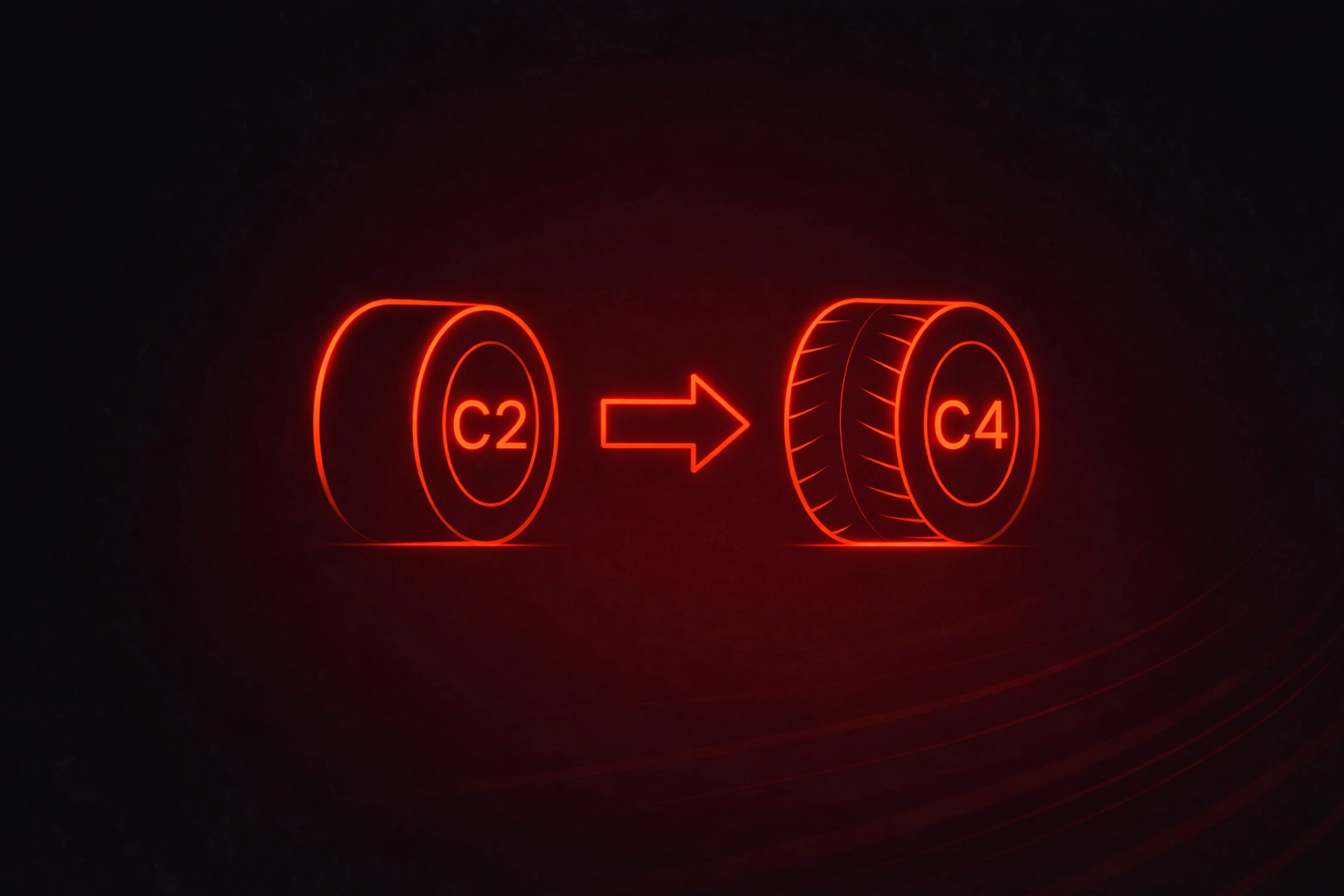
The soft tyre is the easiest lap time in Formula 1 to see — that bright red sidewall, the car suddenly alive on turn-in, the sector time that drops like someone cut a wire. It’s also the easiest lap time to misread, because it hides the part that matters on Sunday: how long that speed stays affordable. And every season, we watch the same confusion play out in real time: fans asking why a team “didn’t just run the faster tyre”, while the pit wall is looking at degradation curves that make the “faster tyre” a short-term loan with brutal interest.
The labeling trap: “Hard” is a weekend role, not a universal truth
First, a reality check: C2 and C4 are not fixed labels for “hard” and “soft” in the abstract — they’re compound IDs in Pirelli’s range, and the weekend’s Hard/Medium/Soft naming is assigned from the three compounds nominated for that circuit. In 2025, Pirelli expanded the slick range out to C1–C6, with C6 as the softest option, giving them more levers to pull when a circuit is trending one-stop by default.
That’s why you’ll see weekends where C2 is literally the Hard tyre (white) — like Silverstone in 2025, where the trio was C2 (Hard), C3 (Medium), C4 (Soft). And you’ll see weekends where C2 isn’t the hard at all — at Suzuka in 2025, C2 was the Medium, because the whole allocation shifted harder (C1/C2/C3). If you’re trying to understand tyre strategy, the first question isn’t “which compound is faster?” — it’s what job is each compound being asked to do at this circuit, in this temperature window, with this pit loss.
When C2 beats C4: the three hidden taxes on the soft tyre
“C2 beats C4” almost never means “C2 is faster in a single lap”. It means something more strategic — that over a stint, the C2 is cheaper. Cheaper on tyre life, cheaper on thermal management, cheaper on risk. And in modern F1, cheap speed wins championships.
1) The degradation tax: pace that collapses is not pace
Soft tyres are built to switch on quickly and deliver peak grip, but that grip can be fragile under sustained energy input. Once the surface overheats, you don’t just lose a tenth — you can lose the entire operating window. That’s when the tyre stops being a lap-time tool and becomes a constraint: the driver starts lifting earlier, avoiding aggressive rotation, protecting traction… and the lap time becomes “managed”. In that state, the “faster compound” is only faster in a highlight reel, not in a 15–25 lap stint.
2) The pit-loss tax: strategy is math before it’s drama
Even if the C4 is quicker, it often requires an extra stop to avoid the degradation cliff. That’s where pit loss becomes decisive. At Silverstone, Pirelli’s own weekend preview context highlighted a pit stop cost of roughly 20.5 seconds, which is low enough to tempt two-stops — but still high enough that traffic and dirty air can erase the theoretical gain. In other words: if your “faster tyre” forces you into an extra pit lane visit, it needs to be fast enough for long enough — and that’s rarer than fans think.
3) The clean-air tax: the best tyre is the one you can use on your terms
A C4 stint in traffic is a waste of its biggest advantage. If you can’t lean on the tyre (because you’re stuck in dirty air, managing fronts, overheating rears on traction), you don’t cash the grip. Meanwhile the C2 is happy being boring: it keeps the platform stable, it resists thermal spikes, and it lets you extend your stint until the race hands you an opportunity — a gap, a Safety Car, a rival committing early.
Case Study 1 — Shanghai: the resurfaced track that made C4 look expensive
The 2025 Chinese Grand Prix weekend is a clean example of the “soft tyre illusion” because the track conditions pushed teams toward stint value over headline pace. Reuters noted that Shanghai’s resurfaced circuit contributed to graining issues, with drivers and teams dealing with tyre management questions as early as practice. And while the weekend allocation set up the classic comparison — C2 as Hard, C3 as Medium, C4 as Soft — the race story leaned heavily toward the C2 doing the heavy lifting.
F1’s own pre-race breakdown captured the key stat fans tend to ignore: in the strategy picture they referenced, C2 accounted for the highest mileage (57%), while the C4 was used far more selectively, with only a handful of drivers choosing it for the start. That’s not because teams forgot the C4 exists — it’s because the soft tyre’s value was situational. If you start on C4, you buy launch grip and early track position, but you also buy an earlier stop, and potentially a second problem: rejoining into traffic with a tyre that needs clean air to stay alive.
This is where “harder was faster” becomes true in practice. Not because the white tyre is magic, but because the lap time you can repeat beats the lap time you can only afford for five laps. Shanghai’s long-radius corners punish surface sliding; once you start scrubbing, the soft tyre stops being “fast” and starts being “fragile”. The C2, by contrast, turns the race into something teams can control: longer stints, wider pit windows, and fewer moments where you’re forced to pit because the tyre has stopped cooperating.
Case Study 2 — Silverstone: when “one step softer” still rewards the white tyre
Silverstone is where fans most often confuse intent with outcome. In 2025, Pirelli went one step softer than the previous year and brought C2/C3/C4 — explicitly to widen strategic options. On paper, that sounds like an invitation to run the C4 aggressively. In reality, it’s often an invitation to do something more subtle: use the C4 where it’s unbeatable (qualifying and the opening phase), and then let the C2 do what wins races — hold pace when the track and fuel load change, and when the wind picks up and the fronts start to complain.
The key detail is that Silverstone isn’t just “fast corners”. It’s fast corners taken in clusters, where tyres don’t get much of a rest, and where the cost of a small slide compounds across the lap. Once you accept that, the strategic picture changes. The C4 becomes a tool for position — a tyre you want when track position is most elastic (the start, the first stop phase, late restarts). But the C2 becomes the tyre that stabilises your race: it’s the compound you can run while the pit wall watches gaps, calculates undercut threat, and decides whether your next stop is a proactive attack or a defensive cover.
And because the pit loss is relatively low at around 20.5 seconds, the temptation is to two-stop — but the risk is traffic. If you bolt on a fresh C4 and rejoin behind a DRS train, you’ve effectively paid for grip you can’t use. That’s the real reason a “harder” tyre can be “faster”: it turns your race into fewer forced moves, and more optional ones.
The championship layer: why consistency mattered more in 2025 (and why it’ll matter in 2026 too)
Tyre strategy is never just about one Sunday — it’s about point accumulation across a season. And 2025 was the perfect reminder, because the title was decided by two points: Lando Norris won the Drivers’ Championship on 423 to Max Verstappen’s 421, with Oscar Piastri on 410. McLaren wrapped the Teams’ title with 833 points, ahead of Mercedes (469) and Red Bull (451).
That context matters because from 2025 onward, there’s no fastest lap bonus point — the FIA removed it, changing the incentive structure for late “free pit stop for softs” gambles. If you’re no longer chasing an extra point for a late red-tyre flyer, the C4’s race value narrows further: it has to earn its keep through track position (an undercut, an overtake phase, a restart), not through a cheap points add-on.
If you want to sanity-check how small strategy decisions swing big outcomes, run your own scenarios in the RaceMate championship calculator: simulate the points swing. With margins that tight, “C2 beats C4” stops being a nerdy tyre debate and becomes a championship skill: knowing when to protect the tyre, when to push, and when to choose consistency over spectacle.
Looking ahead, the grid will change again for 2026 — including the arrival of Cadillac and a reshuffled driver market — but the strategic principle won’t. Whatever the new cars do to wake, weight, and deployment (we’ve already broken down the coming trade-offs in Manual Energy Deployment: Why Driver Skill Will Matter More and Active Aero Explained Without the Hype), the tyre question will still be the same: is this lap time sustainable, or is it a trap?
How to read compound choices like an analyst (not a highlight reel)
If you want to predict when the “harder tyre” will look mysteriously quick, stop reading the sidewall and start reading the conditions. A practical checklist:
- Track energy and layout: long loaded corners (Shanghai, Zandvoort) tax surface temperature; stop-start traction zones tax rears.
- Temperature and wind: cooler air can help softs survive; hot track temps can turn them into graining or overheating problems.
- Pit loss + overtaking difficulty: if overtaking is hard, the “faster” two-stop can be slower in practice because you can’t recover track position.
- Traffic probability: midfield density can erase undercut gains; a durable tyre lets you wait for clean air.
- Points incentives: with no fastest lap point from 2025, late soft stints need to create position — not just a purple sector.
And if you want a deeper framework for thinking about strategy beyond compound names, start with our broader tyre primer: F1 Tyre Strategy Through the Decades — Lessons for Las Vegas.
Conclusion: “Harder was faster” is usually shorthand for “cheaper was faster”
C2 beating C4 isn’t a paradox — it’s a price correction. The soft tyre sells you speed up front, but it can charge you back in degradation, extra stops, and traffic risk. The harder tyre sells you something less dramatic and more valuable: control. Control over stint length. Control over pace drop-off. Control over when your race becomes aggressive, and when it becomes defensive.
Once you start watching F1 through that lens, tyre strategy stops looking like teams refusing free lap time — and starts looking like what it really is: a constant negotiation between peak performance and the cost of maintaining it. And in a points era where titles can swing on two points and the fastest lap bonus is gone, that negotiation is the difference between a “good” tyre call and a championship one.